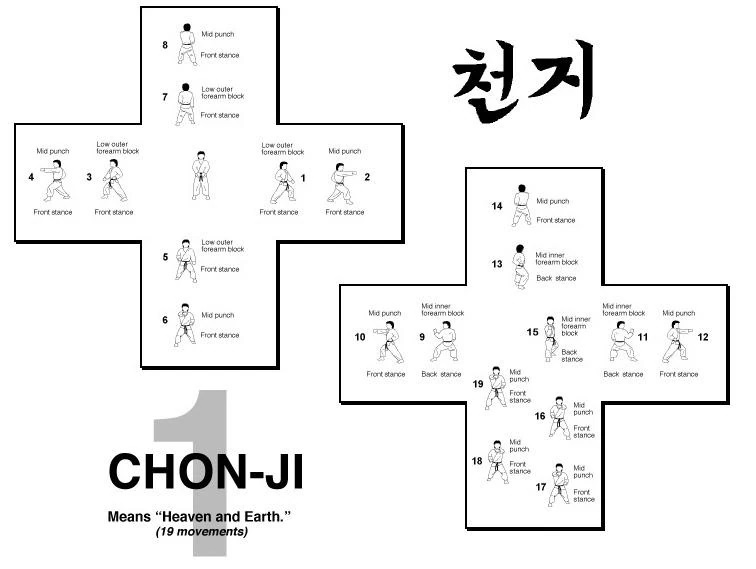
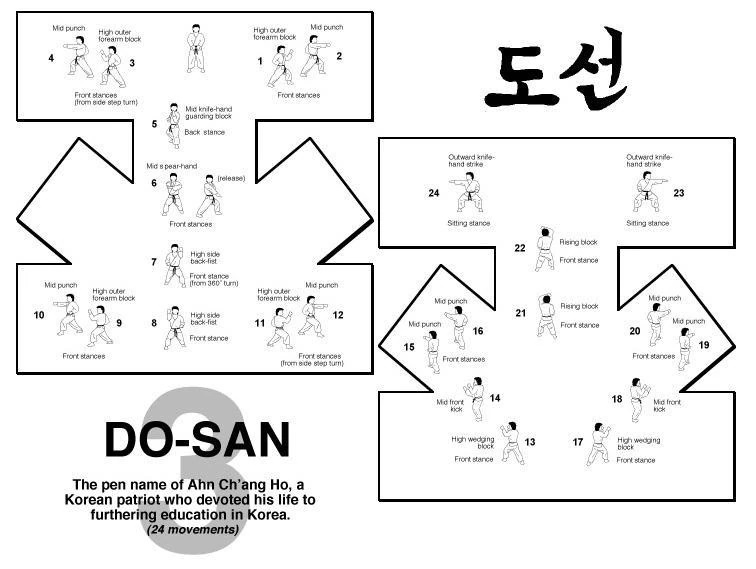
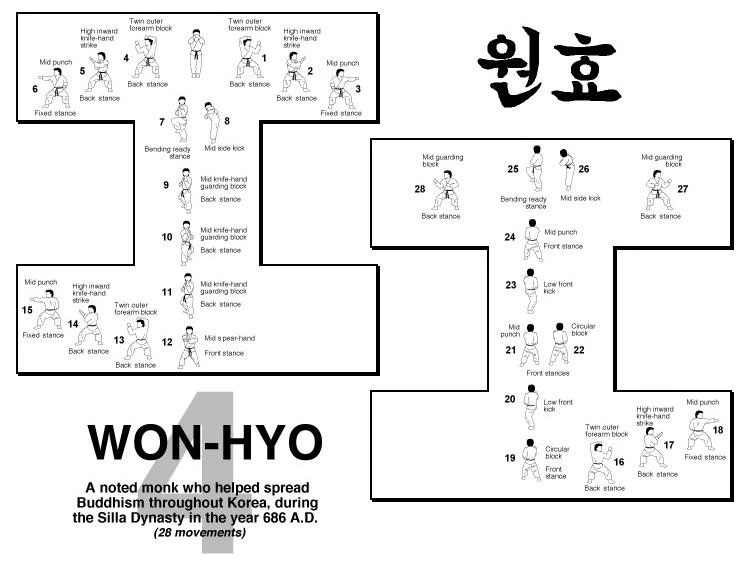
Learning patterns is fundamental to progression in tae kwon do. This is information about the patterns we teach, including how to perform them.
Belt Pattern Moves Shape Meaning Instructions White Chon-Ji 19 Cross, or plus sign Heaven and Earth Chon-Ji Yellow Dan-Gun 21 Capital H or I The legendary founder of Korea in 2333 B.C. Dan-Gun Yellow-Green Do-San 24 S Do-san is the pseudonym of the Korean patriot Ahn Chang-Ho (1876-1938). Its 24 movements represent his entire life which was devoted to preserving the Korean culture during the Japanese occupation and fighting for independence. Do-San Green Won-Hyo 28 Capital H or I Won-Hyo is named after the monk who introduced Buddhism to Korea in 686 AD. Won-Hyo Green-Blue Yul-Guk 38 Scholar's ideogram (mark) Yul-Gok is the pseudonym of the great 16th century philospher and scholar Yi I, the Confucius of Korea. The 38 moves are for his birthplace on the 38th parallel. Blue Joon-Gun 32 Capital H or I Joong-Gun is named for the Korean patriot Ahn Joong-Gun, who assassinated the first Japanese governor-general of Korea. The 32 moves in this pattern are for Ahn Joong-Gun’s age when he was executed in 1910. Blue-Red Toi-Gae 37 Capital H or I Toi-Gye is the pen name of the scholar Yi Hwang, the 16th century authority on neo-Confucianism. The 37 moves of this pattern are for his birthplace on the 37th parallel and the pattern is in the shape of the ideogram for scholar. Red Hwa-Wrang 29 Capital H or I Hwa-Rang was a 7th century youth group responsible for unifying Korea. The 29 moves refer to the 29th infantry division where Tae Kwon Do developed to maturity. Red-Black Same as Red Belt Black Choon-Mu 30 Capital H or I Choong-Moo was the name given to Admiral Yi Soon-Sin who invented the first armored battleship in 1582, the precursor to the present day submarine.
 Livonia Tae Kwon Do